
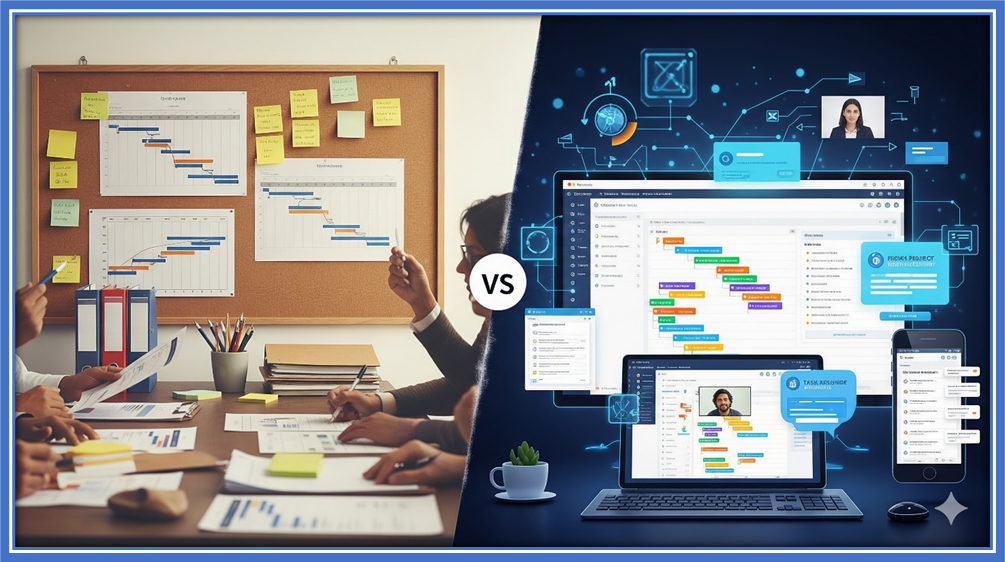
At Digital Capacity Building : The purpose of this document is to analyses the project management approach, methods, and tools that each type uses and to highlight the key differences between them. The focus will be on the necessary adaptations in project management to keep projects in check in the high-paced digital world.
Overview
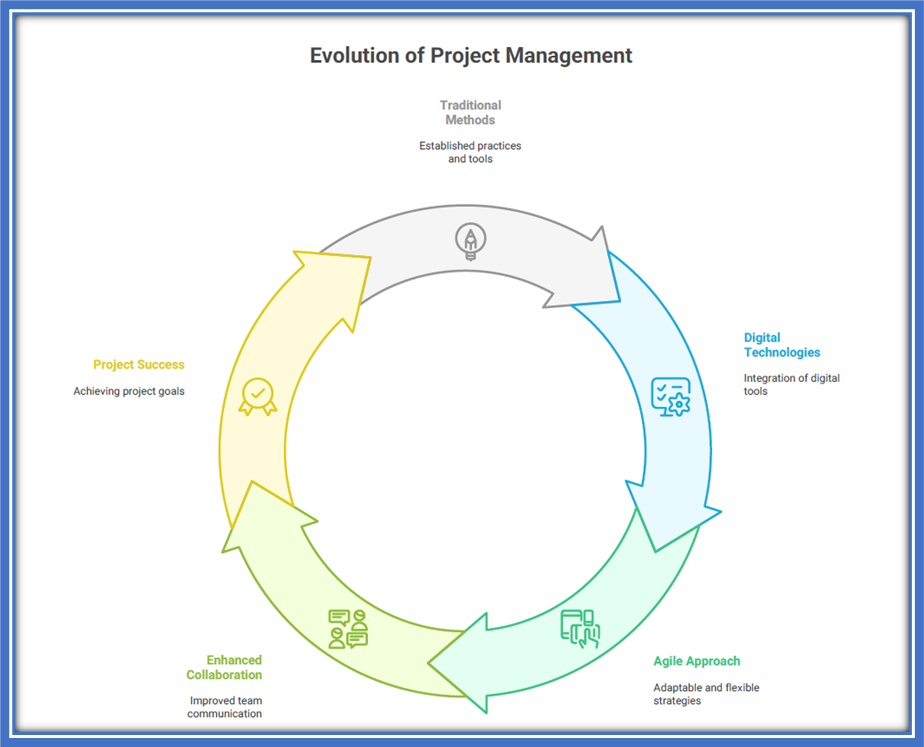
Over time, the approach to handling projects has gained new dimensions. Digital project management is a new and emerging field that has the chance to prove itself. Unlike the traditional methods, it has the chance to outshine the rising complexity of projects together with the boom in technologies. It promises a win in the game of effective management through improved teamwork, enhanced project communication, and greater chances of success for the project as a whole.
Introduction
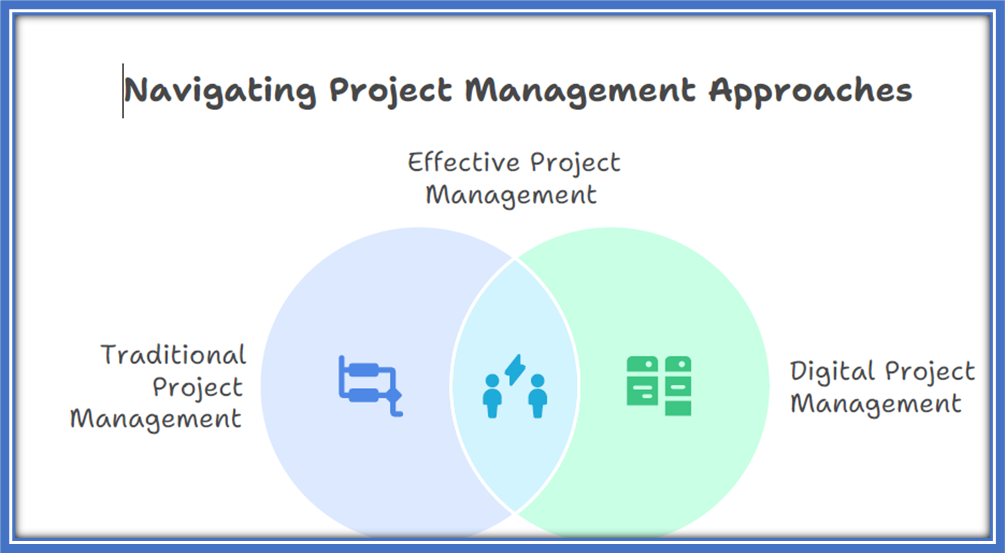
Project management has undergone considerable transformation in recent years. While conventional methods once sufficed, the advent of digital technologies and the growing intricacy of modern projects have rendered traditional approaches less effective. Consequently, digital project management has emerged as a necessary evolution. By utilizing advanced digital tools and innovative methodologies, this approach fosters improved collaboration, streamlines communication, and ultimately increases the likelihood of project success in today’s complex environments.
Traditional Project Management
Traditional project management, often associated with the Waterfall methodology, is fundamentally linear and sequential in its approach. The process unfolds in a series of defined phases—initiation, planning, execution, monitoring and controlling, and closure—where each stage must be completed in full before progression to the next is permitted.
Key characteristics include:
- Waterfall Methodology: Projects are divided into discrete phases. Each phase serves as a prerequisite for the subsequent one, ensuring a clear, stepwise progression from concept to completion.
- Rigid Planning: Considerable effort is devoted to developing comprehensive project plans at the outset. Scope, schedule, and budget are meticulously defined, and any proposed changes are typically subject to formal processes and require documented approval.
- Hierarchical Structure: Authority and responsibility are clearly delineated. The project manager occupies a central leadership role, directing the project and delegating tasks within an established hierarchy.
- Document-Centric: Documentation is pervasive and foundational. Project charters, scope statements, work breakdown structures (WBS), and Gantt charts are standard tools used to guide and record project progress.
- In-Person Communication: Face-to-face meetings and formal communication channels are emphasized, supporting structured collaboration and decision-making.
- Physical Tools: Traditional project management often involves tangible materials such as whiteboards, paper documents, and spreadsheets, underscoring the method’s preference for physical records and tools.
- This approach is best suited for projects where requirements are well understood and unlikely to change, as its structured nature can make adaptation to evolving circumstances challenging.
Advantages:
• Processes are clearly outlined, providing structure and reducing uncertainty throughout project management.
• Roles and responsibilities are explicitly defined, which supports accountability and minimizes confusion among team members.
• Extensive documentation is maintained, aiding both in knowledge transfer and in creating a reliable project history.
• This approach is particularly effective for projects with stable, well-established requirements that are unlikely to change significantly over time.
Disadvantages:
- Inflexibility is a significant concern. When requirements shift or unexpected obstacles arise, adapting can become quite challenging within this framework.
- Feedback cycles are notably slow. Issues may not surface until much later in the process, resulting in time-consuming and often expensive revisions.
- Collaboration tends to be limited. The structure can inadvertently discourage open communication and teamwork among members.
- For complex or rapidly evolving projects, this approach falls short. It often struggles to accommodate the pace and intricacies demanded by modern digital initiatives.
Digital Project Management
Digital project management represents a significant evolution from traditional approaches. This model prioritizes agility, robust collaboration, and the strategic integration of digital tools to coordinate projects more effectively in contemporary work environments. Rather than relying on rigid methodologies, digital project management favors adaptability and responsiveness, particularly in the context of distributed teams and rapidly changing project scopes.
Key Characteristics
- Agile Methodologies: The framework frequently draws upon Agile systems such as Scrum or Kanban, enabling iterative development and continuous feedback, which allows for incremental improvements and enhanced adaptability.
- Flexible Planning: Plans begin at a high level and are continuously refined based on stakeholder input and emergent requirements.
- Collaborative Environment: Team members engage and communicate via digital platforms, ensuring information flow and collective problem-solving.
- Data-Driven Decision Making: Progress is monitored through analytics and reporting, supporting evidence-based adjustments and risk mitigation.
- Digital Tools: Tools for project planning, task management, communication, and reporting are fundamental, ensuring efficiency and transparency.
• Remote-Friendly Structure: The approach is designed to accommodate remote and distributed teams, breaking down geographical barriers.
Advantages
• Adaptability: The methodology is well-suited to projects where requirements evolve or unexpected challenges arise.
• Expedited Feedback Loops: Issues are identified and resolved more quickly through regular review cycles.
• Enhanced Collaboration: Digital tools foster improved communication and teamwork.
• Efficiency Gains: Automation and streamlined processes reduce manual workload and improve overall productivity.
• Data-Driven Insights: Access to real-time analytics supports informed decision-making.
• Effective for Dynamic Projects: Particularly advantageous for complex, fast-evolving digital initiatives.
Disadvantages
• Organizational Culture Shift: Successful adoption often requires a significant change in mindset and organizational culture.
• Implementation Challenges: Teams require dedicated training and support to utilize digital project management approaches effectively.
• Demand for Communication Skills: High levels of collaboration and communication are essential, and deficiencies in these areas can undermine effectiveness.
• Risk of Scope Creep: Without careful management, iterative planning may lead to uncontrolled project expansion.
Key Differences Summarized
Compared to traditional project management, digital project management demonstrates greater flexibility, a stronger reliance on technology, and a design tailored for environments where rapid adaptation and distributed collaboration are critical. Where conventional models may resemble a linear, predetermined path, digital project management is more analogous to a dynamic, adaptive process, accommodating change and complexity as inherent project elements.
Selecting the Appropriate Method: Traditional vs. Digital Project Management
Ultimately, the decision between traditional and digital project management hinges on the specific context of the project and the surrounding organization.
- If the project features clearly defined requirements, operates in a stable environment, and demands rigorous oversight, then traditional project management methods are typically more effective. This approach prioritizes structure, predictable workflows, and detailed planning.
- Conversely, when faced with complex objectives, rapidly shifting circumstances, or the need for ongoing collaboration, digital project management emerges as the more suitable choice. Its inherent flexibility and emphasis on communication support teams in adapting to evolving demands.
- Occasionally, the most effective strategy involves integrating elements of both models—a hybrid approach—to address the unique needs of the project and organization.
Conclusion
Digital project management marks a major shift in how we handle projects. By adopting agile methods, utilizing digital tools, and encouraging teamwork, organizations can boost their project success rates, cut down on costs, and stay flexible in the fast-paced digital world. While traditional project management still has its role, the future clearly leans towards the principles and practices of digital project management. The trick is to recognize the strengths and weaknesses of each method and select the one that aligns best with the unique needs of the project and the organization.
“🚀 Looking for more insights? Look at the best management software in 2025- https://thedigitalprojectmanager.com/tools/best-project-management-software/
👉 Dive into our extensive collection of project management e-books and revolutionize your approach today.
📩 Have a specific need? Reach out to us for tailored solutions!”https://forms.gle/pXnN1aCznxs2UoSY6
Extra Resource- This is a book, an example of traditional management, which is now available digitally. If interested in drafting a project proposal: https://www.youtube.com/watch?v=GNlFSch2-Lw or https://digitalcapacitybuilding.com/wp-admin/post.php?post=606&action=edit